
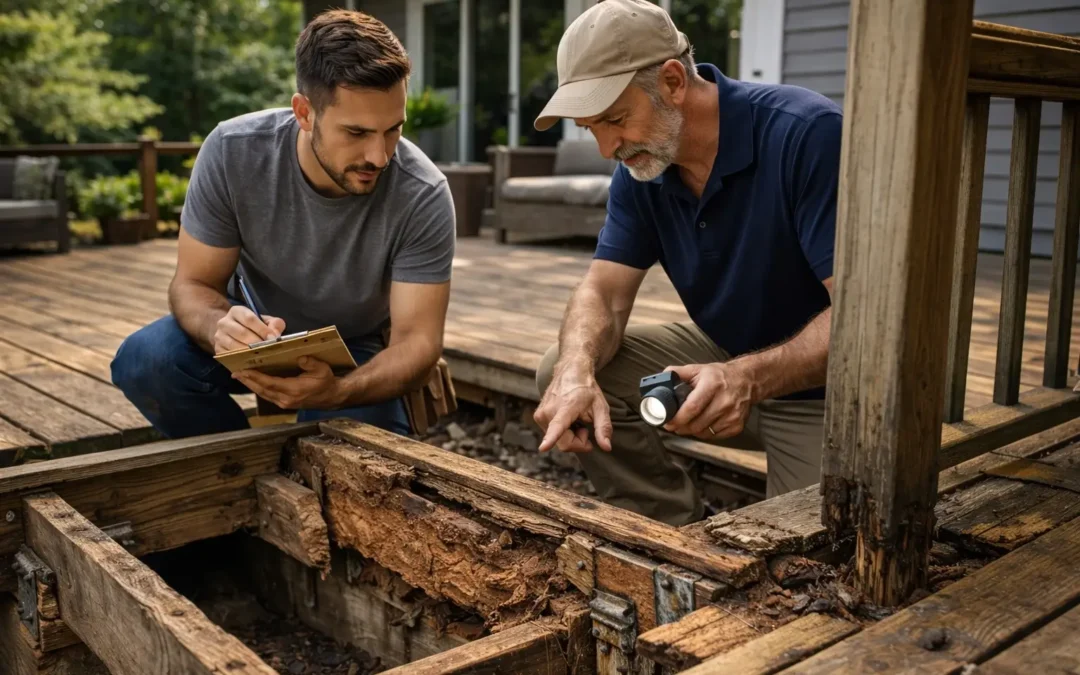
A worn deck does not always need to be torn down. Sometimes a few new boards, fresh fasteners, or a professional staining and repair job can bring it back to life. But there comes a point when repairs stop being the smart option. If the structure underneath is failing, the deck feels unsafe, or you are fixing the same problems every year, a full replacement is often the better long-term decision.
For homeowners, the hard part is knowing where that line is. Many decks still look “mostly okay” from the surface while the framing, posts, or connection to the house are already compromised. This guide walks through the most important warning signs so you can tell when your deck needs more than another patch job.
When Repair Is No Longer Enough
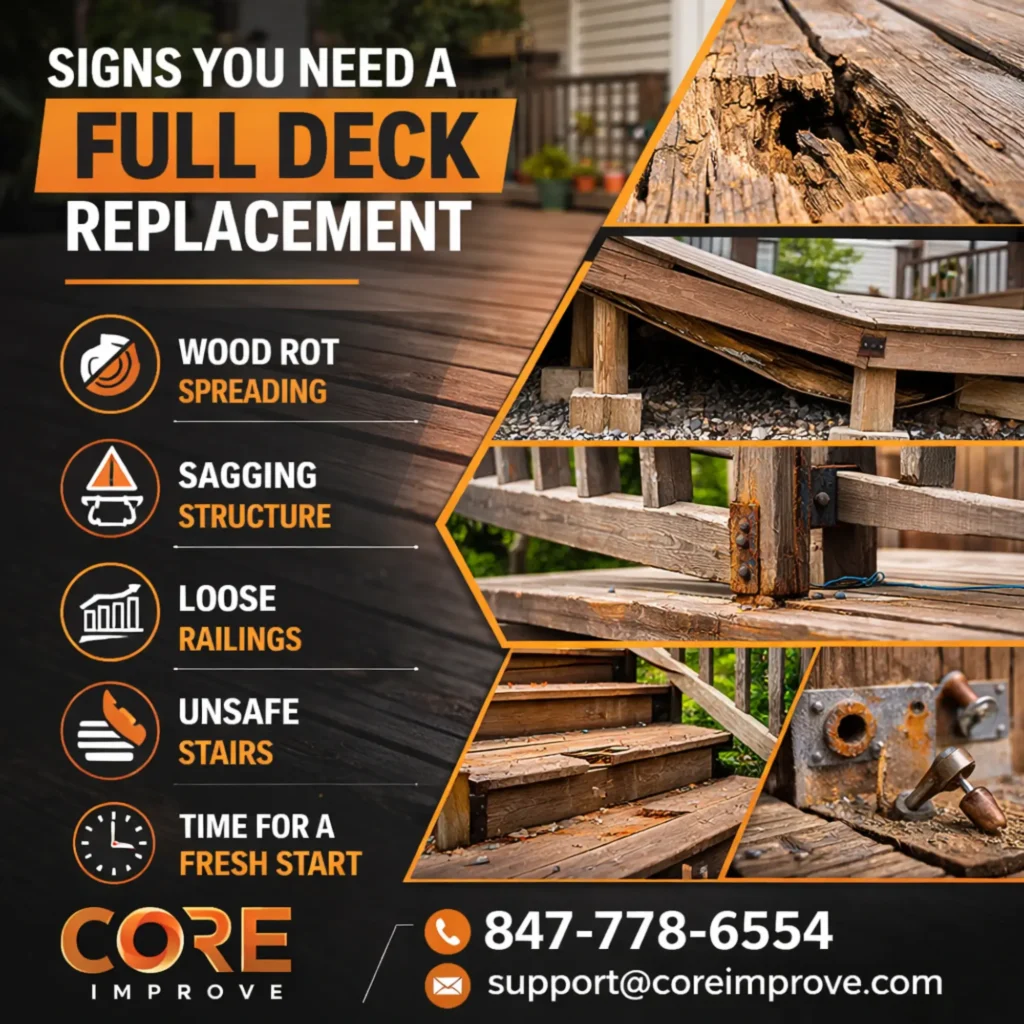
A full deck replacement is usually the right move when the damage goes beyond surface-level wear. If the problem affects the framing, support posts, stairs, railings, or the way the deck connects to the house, repairs become less reliable and often less cost-effective.
The simplest rule is this: if the deck is structurally unsafe, or if multiple structural areas are failing at once, replacement is usually smarter than continuing to fix it piece by piece. A few bad boards can be replaced. A failing substructure usually cannot be “spot fixed” with confidence.
1) Widespread Rot and Soft, Spongy Wood
Wood rot is one of the clearest signs that a deck may be nearing the end of its life. If you step on the deck and feel soft spots, or if boards seem spongy underfoot, that is more than cosmetic wear. It usually means moisture has been sitting in the wood long enough to break it down.
The key issue is whether the rot is isolated or widespread. If one or two surface boards are bad while the framing below is still solid, repairs may still make sense. But if rot shows up in multiple areas, especially near joists, beams, or support posts, the structural integrity of the deck is already being compromised.
Rot is also deceptive. What you see on top is often less severe than what is happening underneath. Moisture gets trapped where boards meet joists, where the deck meets the house, and around hardware connections. By the time the top surface feels soft, the hidden damage may already be extensive.
2) The Deck Feels Bouncy, Swaying, or Sagging
A deck should feel stable when you walk across it. If it bounces, flexes, or shifts noticeably, that is a warning sign that something important is failing below the surface.
A spongy or bouncy feeling can point to weakened joists, deteriorating fasteners, or framing that is no longer supporting weight properly. Swaying is especially concerning because it can mean the posts, beam connections, or overall structural system are losing stability.
Visible sagging is another major issue. If one corner dips, the deck line looks uneven, or stairs seem to be pulling away, those are not minor appearance problems. They often indicate deeper structural failure. Once a deck starts sagging, the conversation usually shifts from simple repair to full evaluation for replacement.
3) Damage to the Ledger Board or House Connection
One of the most critical parts of any attached deck is the ledger board, which ties the deck to the house. If that area starts failing, the safety risk increases significantly.
Damage around the ledger board can include rot, loose fasteners, rusted connectors, or signs that the deck is separating from the house. Water intrusion in this area is especially dangerous because it can affect both the deck structure and the home’s framing.
This is one of the biggest replacement-level warning signs because the ledger board is not a cosmetic feature. It is one of the primary structural anchors of the entire deck. If that connection is compromised, patching a few boards on the surface will not solve the real problem.
4) Failing Posts, Beams, or Joists
The strength of a deck depends on what is underneath. Surface boards matter, but posts, beams, and joists are what actually carry the load.
Support posts often start failing at the bottom, especially where they meet the ground or concrete. Constant moisture exposure can cause rot right where it is hardest to notice at first glance. If a post is soft, split, leaning, or visibly deteriorated, the deck is no longer being supported the way it should be.
Joists and beams can also rot, crack, sag, or weaken over time. This type of damage often stays hidden until someone crawls underneath or the deck starts feeling unstable. Once the framing is compromised in multiple places, repairs become more expensive, more complicated, and less predictable. At that point, replacement is often the safer investment.
5) Loose Railings and Unsafe Stairs
Wobbly railings are not a small annoyance. They are a serious safety issue. If railings shift when you lean on them, pull away from posts, or feel loose at connection points, they need immediate attention.
The same is true for stairs. Shaky steps, rotting stringers, uneven treads, or visible movement when using the stairs can all signal that the deck system is aging out. In some cases, stairs and railings can be repaired without replacing the entire deck. But when those problems appear alongside rot, sagging, or framing issues, they usually point to a bigger structural problem.
This is where many homeowners underestimate the risk. A deck can still “look usable” while railings and stairs are already unsafe for children, guests, or anyone using the deck regularly.
6) Rusted or Corroded Hardware Throughout the Deck
Fasteners and hardware hold the entire deck together. Nails, screws, joist hangers, brackets, bolts, and connectors all play a structural role. If corrosion is widespread, the deck can weaken even if the wood still looks decent from above.
Some rust on older hardware is not unusual. The problem is when corrosion is heavy enough that fasteners are loosening, connectors are deteriorating, or metal components are no longer holding securely. In those cases, the issue is no longer cosmetic.
Corrosion often shows up more severely in hidden areas, especially around joist hangers, beam connections, and the ledger board. If hardware failure is happening throughout the structure, a deck replacement often makes more sense than trying to replace individual metal components across an aging frame.
7) The Deck Is 15–20+ Years Old and Showing Its Age
Age alone does not automatically mean a deck has to be replaced. A well-maintained deck can last a long time. But once a wood deck is pushing past the 15- to 20-year range and showing multiple warning signs, replacement becomes much more likely.
Older decks often hide problems better than newer ones. The surface may still look “good enough,” especially after a fresh cleaning or stain, but the framing below can tell a very different story. Wood dries out, expands, contracts, and weathers over years of exposure, and eventually those cycles take a toll.
When age combines with soft spots, loose railings, sagging, rusted hardware, or recurring repairs, it is usually a signal that the deck is nearing the end of its practical life.
8) Pest Damage and Hidden Structural Destruction
Termites, carpenter ants, carpenter bees, and other wood-damaging pests can weaken a deck from the inside out. One of the biggest problems with pest damage is that it often affects hidden structural members before homeowners notice it on the surface.
If you see tunneling, bore holes, crumbling wood, or repeated insect activity around the deck, that is a strong reason to get the structure evaluated. Pest damage is especially concerning when it affects posts, joists, beams, or stair framing.
In some situations, limited pest damage can be repaired. But when the infestation has spread through multiple hidden areas, replacement is often the only dependable solution.
9) You Keep Repairing It Every Year
One of the clearest practical signs that you need a full deck replacement is simple: you keep spending money on repairs, but the deck never really feels “fixed.”
Maybe one year it is the stairs. Next year it is loose railings. Then it is a few rotted boards, followed by hardware replacement, then more staining, then another framing concern. At some point, the cost and effort of repeated repairs stop making financial sense.
This is where many homeowners finally realize that they are maintaining a failing structure instead of investing in a reliable one. If your deck is becoming a recurring annual project, replacement may actually be the more cost-effective route.
10) When to Stop Using the Deck Immediately
Some deck issues should not wait. If your deck has severe sway, obvious sagging, major soft spots, sinking posts, badly deteriorated stairs, or railings that feel unsafe, it may no longer be safe to use.
This is especially important if the deck is elevated. Structural failure in an elevated deck can lead to serious injury. If you notice major movement or visible structural damage, stop using the deck until it has been professionally inspected.
A common mistake is assuming, “It held up this long, so it’s probably fine for a little longer.” That kind of guessing is exactly what turns warning signs into accidents.
Repair or Full Deck Replacement: How to Decide
There are still many situations where repair makes sense. If the framing is sound, the damage is isolated, and the problems are limited to a few boards, localised hardware replacement, or minor stair/railing issues, you may not need a full rebuild.
Replacement is the smarter choice when the substructure is compromised in multiple areas, when the ledger board or major framing members are failing, or when the deck is old and the problems keep returning. The real question is not whether the deck can be repaired at all. Almost anything can be repaired with enough money. The better question is whether it makes sense to keep investing in an aging structure.
What a Professional Deck Inspection Should Look For
A proper deck inspection should go far beyond looking at the top boards. A professional should evaluate the surface decking, joists, beams, posts, footings, stairs, railings, hardware, and the ledger board where the deck connects to the home.
They should also look for moisture traps, drainage issues, areas of repeated water exposure, and signs of hidden decay. This kind of inspection helps determine whether the deck can realistically be repaired or whether replacement is the safer and more cost-effective option.
Core Improve: Help for Homeowners Deciding Between Repair and Replacement
For homeowners in the Chicago suburbs, this is where working with the right contractor matters. Core Improve helps homeowners evaluate whether a deck can be saved with targeted repairs or whether it is time for a full Deck Building & Deck Replacement project. When the structure is still sound, services like Deck Staining & Deck Repair can help extend the life of the deck and improve its appearance. But when the framing, posts, stairs, or ledger connection are failing, a rebuild is often the smarter path. The goal is not to oversell replacement. It is to make the right call based on safety, condition, and long-term value.
Final Thoughts
The biggest signs you need a full deck replacement are not just visual. They are structural. Widespread rot, a bouncy or sagging feel, failing posts or joists, unsafe stairs and railings, rusted hardware, pest damage, and constant repairs all point to the same conclusion: the deck may no longer be worth patching.
If the problem is isolated, repairs can still make sense. But if the damage is structural or spread across multiple parts of the deck, replacement is often the safer and more cost-effective decision. In those cases, rebuilding is not overkill. It is the right next step.
FAQs
How do I know if my deck needs to be replaced instead of repaired?
If the damage affects the framing, posts, ledger board, stairs, or multiple structural areas, replacement is usually the better option.
What are the biggest warning signs of deck failure?
Widespread rot, soft or spongy wood, sagging, swaying, loose railings, unsafe stairs, and corroded hardware are among the biggest red flags.
Can rotted deck boards be replaced without replacing the whole deck?
Yes, if the rot is limited to a few surface boards and the framing underneath is still solid.
How long does a wood deck usually last?
A wood deck often lasts around 15 to 20 years, depending on maintenance, weather exposure, and construction quality.
Is a sagging deck dangerous?
Yes. Sagging usually points to structural failure and should be inspected right away.
What part of a deck fails most often?
Common failure points include the ledger board, joists, support posts, stairs, and railings.
Should I replace my deck if the railings are loose?
Not always, but loose railings are a serious safety issue. If they occur alongside other structural problems, replacement may be necessary.
Can old deck joists still be safe if the surface boards are bad?
Sometimes. If the joists are structurally sound, the deck boards may be replaceable without a full rebuild.
Is it cheaper to repair or replace a deck?
It depends on the condition. Small, isolated repairs are cheaper. But when structural damage is widespread, replacement is often more cost-effective in the long run.
When should I stop using my deck immediately?
If it sways heavily, sags, has major rot, unsafe stairs, failing railings, or signs of post or framing failure, stop using it until it has been inspected.