
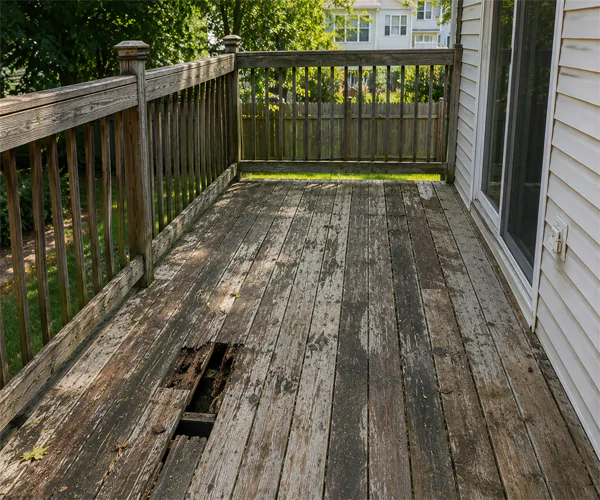
The ledger board is the piece of lumber that fastens your deck to your house. It is bolted or lag-screwed to the home’s rim joist, and it carries the house side of the deck’s weight. When the flashing above it fails, water gets in behind the ledger, soaks the rim joist, and slowly weakens the one connection that keeps the deck attached to the building. Ledger rot is hard to see from the deck surface, so by the time most homeowners notice something is off, the damage has often been building for several seasons. This guide covers the warning signs, why ledgers fail on Chicago-area decks, what a proper deck ledger board repair involves, and how to tell when repair is no longer the right answer.
What a Failing Ledger Board Looks Like
Ledger problems rarely announce themselves. The signs below are the ones worth checking for at least once a year, and any time you notice the deck feels different underfoot.
- A gap between the deck and the house. If the deck frame is pulling away from the siding, the ledger or its fasteners may be losing their grip.
- Rust streaks below the ledger. Staining that runs down from the bolts or hangers means water is sitting at the connection and the hardware is corroding.
- Soft or spongy wood near the wall. Press a screwdriver into the ledger and the rim joist behind it from below. Wood that gives easily is rotting.
- Bubbling paint, swollen trim or stains on the siding above the deck. These can mean water is getting behind the wall at the deck line.
- Moisture or stains on the basement or crawl space side of the rim joist. If you can see the inside of the rim joist, look for dark staining or soft spots where the deck attaches.
- Nails only, no bolts or lag screws. Look at the face of the ledger. If all you see are nail heads, the deck may be held on by nails alone.
That last one matters more than most homeowners realize. The International Code Council has pointed to nail-only ledger connections as a common cause of deck collapses, because nails pulled in withdrawal have limited strength. Current code calls for bolts or lag screws in a set pattern, and the ICC recommends a professional evaluation of the ledger connection on any elevated deck. Our guide on how to inspect a wooden deck for safety walks through a fuller checklist.
Why Ledger Boards Rot
Flashing that was never installed, or has failed
Flashing is the metal or membrane barrier that sheds water away from the joint between the ledger and the house. On many older decks, it is missing entirely, or the builder relied on a bead of caulk along the top of the ledger. Caulk dries out, cracks and pulls away within a few seasons. Once it does, rain and snowmelt run straight into the gap behind the ledger and stay there.
Ledgers attached to the wrong part of the house
A ledger needs a solid structural backing. Fastening one to brick or stone veneer, or through thick layers of siding without proper spacers and flashing, creates both a water trap and a weak connection. Municipal deck handouts in the Chicago suburbs, such as Palatine’s, state plainly that deck ledgers cannot be attached to masonry veneer.
Chicago’s freeze-thaw cycles
The Chicago area goes through many freeze-thaw cycles each winter. When water gets behind a ledger and into the rim joist, it freezes, expands, thaws and soaks in again, over and over. That repeated wetting and swelling opens the wood fibers, loosens fasteners and speeds up rot far beyond what the same wood would see in a drier climate. Pressure-treated lumber resists decay better than untreated wood, but no treated board holds up indefinitely if it stays wet at the house connection.
Older building practices
According to the ICC, detailed ledger-fastening requirements have appeared in the International Residential Code since its 2009 edition. Many decks across Chicagoland are older than that, which means they were built before those prescriptive tables existed, and some were built without a permit at all. Age alone does not mean a ledger is failing, but it is a good reason to have the connection looked at.
What a Deck Ledger Board Repair Involves
A ledger repair is structural work. It usually follows this sequence:
- Temporary support. The deck frame near the house is shored up so the ledger can be removed safely.
- Removing decking along the house wall. The first few rows of deck boards come up to give access to the ledger and joist hangers.
- Removing the damaged ledger and inspecting the rim joist. This is the point where the true scope becomes clear. Sometimes the rot stops at the ledger. Sometimes it has reached the rim joist, the sheathing or the framing inside the house.
- Repairing the house side. Damaged rim joist sections are sistered or replaced, and any wet sheathing is addressed before anything is closed back up.
- Installing proper flashing. A self-adhering membrane over the rim joist and a rigid cap flashing over the top of the ledger, lapped so water sheds outward. Flashing is a code requirement, not an upgrade, and caulk is not a substitute for it.
- Installing a new ledger with code-approved fasteners. Through-bolts or lag screws in the spacing set by the code table your municipality uses, or an approved alternative connection.
- Re-hanging joists and reinstalling decking. New hangers where the old ones are corroded, then the deck boards go back down or are replaced if they did not survive removal.
If the inspection turns up problems beyond the ledger, such as rotted joist ends, failing posts or footings that have moved, those are addressed in the same project rather than left for later. Core Improve’s deck repair service covers ledger replacement, joist sistering, post and footing work, and the surface repairs that go with them.
Permits and Code Basics for Ledger Repair
Do you need a permit?
In most Chicago-area municipalities, structural deck work, including ledger replacement, post or footing replacement and joist repair, is treated as work that needs a building permit and inspection. Swapping out a few deck boards often does not. The rules are set locally, so confirm with your village or city building department before work starts. A permitted, inspected repair is also easier to document when you sell the house, and it gives you a record that the connection was built to code.
Which code applies?
Chicago suburbs generally base their deck rules on the deck section of the International Residential Code (Section R507), often with local amendments and a deck handout that spells out what inspectors want to see. Palatine’s current handout, for example, states that all decks must comply with the 2021 IRC Section R507. Your town may use a different edition or add its own requirements, so ask your building department which version applies.
Footing depth
If a ledger repair turns into post or footing work, new footings have to go below the frost line. Many municipalities in the Chicago area require footings for attached decks to reach at least 42 inches below grade. Palatine and Des Plaines both publish that figure in their deck handouts. Free-standing decks can have different rules in some towns. Shallow footings are one reason older decks heave and rack over the winter, which in turn puts stress on the ledger.
What Affects the Cost of Ledger Board Repair?
No two ledger repairs are the same, and the scope is often not fully known until the old ledger comes off. The main factors are:
- How far the rot has spread. A ledger-only replacement is a much smaller job than one where the rim joist, sheathing or interior framing also needs repair.
- Deck size and ledger length. A longer ledger means more decking to remove, more fasteners and more flashing.
- Access. Second-story decks, tight side yards and decks over patios or landscaping take more time to shore and work on safely.
- Decking that has to be removed. Some boards come up and go back down. Older or composite boards may need to be replaced.
- Siding and wall type. Vinyl, wood, fiber cement and masonry each require a different approach at the connection.
- Additional structural work. Joist sistering, new hangers, post replacement and the number of new footings all add to the scope.
- Permit requirements. Fees and inspection steps are set by each municipality.
The only reliable number comes from an on-site inspection. Core Improve provides free on-site estimates and explains what was found at the ledger before quoting the work.
Repair or Replace?
A deck with a solid frame and ledger damage limited to one section is usually a good repair candidate. Replacement starts to make more sense when:
- Rot has spread from the ledger into many joists or the beam.
- Several posts or footings have failed at the same time.
- The deck was built without proper footings or connections and would need to be largely rebuilt to meet code.
- The decking surface is also near the end of its life.
Age is part of the picture, but condition matters more. A well-built older deck with one bad ledger section can be worth repairing, while a newer deck built poorly from the start may not be. Our guides on whether to repair or replace your deck and the signs you need a full deck replacement go into more detail. If a new deck is the right call, Core Improve’s deck building and replacement service handles the full process from design through final inspection.
FAQ: Deck Ledger Board Repair
Can a rotted ledger board be repaired, or does it have to be replaced?
A rotted ledger is replaced, not patched. The real question is what is behind it. If the rim joist and sheathing are sound, the job is a ledger replacement with new flashing and fasteners. If rot has reached the rim joist, that section is repaired or replaced as part of the same project.
Do I need a permit to replace a deck ledger board?
In most Chicago-area towns, yes. Ledger replacement is structural work, and municipalities commonly require a permit and inspection for it. Replacing a few deck boards usually does not need one. Check with your local building department, since each municipality sets its own rules and fees.
What affects the cost of deck ledger board repair?
The extent of rot behind the ledger, the length of the ledger, how much decking has to come up, access, the type of siding, any additional joist, post or footing work, and local permit requirements. Core Improve provides free on-site estimates so the price reflects what is actually found at your house connection.
How can I tell if my deck is only nailed to the house?
Look at the face of the ledger from below the deck. Bolt heads, washers or lag screw heads should be visible in a regular pattern. If you only see nail heads, the connection likely does not meet current code, and it should be evaluated by a professional before the deck is used for gatherings.
The Bottom Line
The ledger board is the most important connection on an attached deck and one of the hardest to see. Missing or failed flashing lets water in, Chicago’s freeze-thaw cycles speed up the rot, and older decks were often built before current ledger fastening rules existed. Catching the early signs, such as a gap at the house wall, rust streaks or soft wood near the siding, keeps a ledger repair from turning into a rim joist or full deck replacement. Structural ledger work generally needs a permit, and any new footings must reach the frost depth your municipality requires.
Book a free on-site estimate with Core Improve
Reviewed by Roman Ivanchuk, Owner of Core Improve
Roman Ivanchuk has 20+ years of experience in deck repair, deck restoration, deck building, and exterior services across the Chicago suburbs.